Last updated: June 2026

Ask any parent who has taken their children to Laikipia what surprised them most, and many will say the same thing: how much the kids learned — without ever feeling like they were in a classroom. A safari here is one of the richest educational experiences a child can have, bringing to vivid life everything from ecology and animal behaviour to conservation, geography and other cultures. And Laikipia, as Kenya’s conservation heartland, is uniquely placed to teach it, with junior ranger programs, tracking lessons, real conservation work to witness, and the last northern white rhinos on earth. This guide to educational safari experiences in Laikipia shows how to turn a family holiday into the kind of learning that sticks for life — the hands-on, real-world education that no textbook or documentary can match.
The best lessons don’t feel like lessons at all. Here’s how a Laikipia safari quietly educates and inspires children.
Why Laikipia Is a Living Classroom
Laikipia is arguably the best place in Kenya for an educational safari, precisely because it’s where conservation actually happens. Unlike a national park where you simply watch wildlife, Laikipia’s conservancies let children see and engage with real conservation — anti-poaching, endangered species recovery, community partnerships, the whole conservation model — up close. Children can meet the last two northern white rhinos, learn why species become endangered, understand how protecting wildlife and helping communities go hand in hand, and witness science and conservation in action. This turns abstract concepts into tangible, emotional, unforgettable experiences. A child who has tracked a rhino, met its keepers and understood its plight grasps conservation in a way no lesson ever could. Add the ecology, geography (the equator!), wildlife biology and cultural learning woven into every day, and a Laikipia safari becomes a living classroom of extraordinary depth — education by immersion, which is the most powerful kind there is.
Junior Ranger and Bush Skills Programs
The most structured educational experiences are the dedicated kids’ programs. The Ol Pejeta Junior Ranger program is the standout: children aged roughly four to twelve learn wildlife tracking, fire-building, wilderness survival and conservation, working through an activity booklet before reciting the ranger oath and earning a certificate, hat and pin. It’s learning disguised as the best kind of fun. El Karama’s Bush School similarly teaches children about the bush through track-casting, scavenger hunts and crafts. These programs are brilliantly designed to educate through hands-on activity and play, covering ecology, animal behaviour, conservation and bush skills in ways that captivate children and make the learning stick. For kids, becoming an honorary ranger or bush-school graduate is a source of huge pride and a genuine introduction to the natural world. These programs are reason enough to choose a family-friendly Laikipia lodge, transforming a safari into an active, memorable education.

Tracking, Ecology and Reading the Bush
Some of the richest learning happens informally, out in the bush with a great guide. Learning to track — identifying animal footprints, dung, feeding signs and other clues — turns children into nature detectives and teaches them to observe closely and think like a scientist. Guides explain the web of the ecosystem: how predators and prey balance, how plants and animals depend on one another, why water and corridors matter, how the whole system fits together. Children learn to identify birds by sight and call, recognise plants and their uses, and understand animal behaviour by watching it unfold. This kind of experiential ecology, learned in the field rather than from a page, is profoundly effective, building genuine understanding and curiosity. A skilled guide who knows how to engage young minds is the key, turning every walk and drive into a fascinating lesson. Children come away not just having seen animals but having begun to understand how nature works — a foundation of scientific literacy and wonder.
Conservation Education in Action
Laikipia’s greatest educational gift is letting children witness conservation for real. Through conservation experiences, kids can learn about anti-poaching efforts and meet ranger or canine teams, understand rhino monitoring and protection, and grasp why and how endangered species are being saved. Meeting the last northern white rhinos at Ol Pejeta is a powerful, emotional lesson in extinction and conservation that stays with children forever. Visits to the chimpanzee sanctuary teach about rescue and rehabilitation. Children learn that conservation isn’t abstract but a real, ongoing effort by dedicated people, funded in part by their own family’s visit. This understanding fosters empathy, responsibility and often a lasting passion for protecting wildlife. For many children, seeing conservation in action in Laikipia is genuinely formative, planting seeds of environmental awareness that grow for a lifetime. It’s education with a purpose, connecting children emotionally to the natural world and their role in protecting it.
Wildlife Journaling and Citizen Science
Simple tools can deepen children’s engagement and learning enormously. Encourage kids to keep a wildlife journal — recording the animals they see, sketching them, noting behaviours and writing about their experiences — which sharpens observation, reinforces learning and creates a treasured keepsake. A wildlife checklist or identification guide turns spotting into an educational game. Older children can get involved in elements of citizen science, helping record sightings or data that contribute to real monitoring, which gives a powerful sense of purpose and shows how observation feeds conservation. Photography, too, teaches children to look closely and patiently at the natural world. These activities transform passive watching into active learning, engaging children’s minds and making the experience more meaningful and memorable. A nature journal kept on safari often becomes a child’s most treasured souvenir, and the habit of careful observation it builds is a genuine educational gift that extends far beyond the trip itself.
Cultural and Geographic Learning
Education on a Laikipia safari extends well beyond wildlife. Cultural encounters with Samburu and Maasai communities teach children about different ways of life, traditions and worldviews, fostering empathy, curiosity and global awareness in a way that’s impossible from home. Standing on the equator near Nanyuki, with the famous water demonstration, is a memorable geography and science lesson. Children learn about Kenya, Africa, the climate, the landscape and the people, broadening their horizons and challenging assumptions. They encounter a world utterly different from their own and return with a richer understanding of the planet and its diversity. This cultural and geographic learning is one of the great gifts of travel for children, developing the open-mindedness and curiosity that serve them throughout life. A Laikipia safari, in other words, educates the whole child — about nature, science, conservation, culture and geography — making it one of the most enriching family trips imaginable.
Making Learning Fun, Not Forced
The secret to educational travel with children is that it must never feel like school. The beauty of Laikipia is that the learning happens naturally, through excitement, play and genuine wonder, rather than instruction. The trick for parents is to follow the children’s curiosity, let the guides and programs do the teaching through fun activities, and resist the urge to turn everything into a quiz. Children learn best when they’re enthralled, and a safari enthrals effortlessly — the learning is a by-product of the adventure. Choose lodges with kids’ programs and great guides, build in the hands-on experiences, provide simple tools like journals and binoculars, and then let the magic happen. Don’t over-structure or pressure; the rhino your child meets, the track they identify, the Samburu warrior they chat to will teach them more than any lesson, precisely because it’s real, exciting and joyful. That’s the genius of an educational safari: the most profound learning disguised as the best holiday of their lives.
Pre-Trip Learning: Building Excitement and Knowledge
The educational value of a safari multiplies if children arrive already curious and informed, so the learning ideally begins weeks before you travel. Read books about African wildlife, conservation and Kenya together; watch nature documentaries about elephants, rhinos, big cats and the savannah; look at maps and a globe to show where Laikipia is and find the equator; and talk about what you’ll see and do. Let children research an animal they’re excited about, or learn a few facts to share. This pre-trip learning primes children to recognise and understand what they encounter, turning each sighting into a thrilling moment of ‘I know about that!’ rather than mere novelty, and deepening their engagement enormously. It also builds anticipation, making the trip feel like the culmination of a project. For school-age children, the safari can even tie into things they’re studying. A little preparation transforms children from blank slates into eager, knowledgeable young explorers, and ensures they get far more out of the educational riches a Laikipia safari offers. It’s one of the simplest ways to maximise the learning.
Learning About Endangered Species
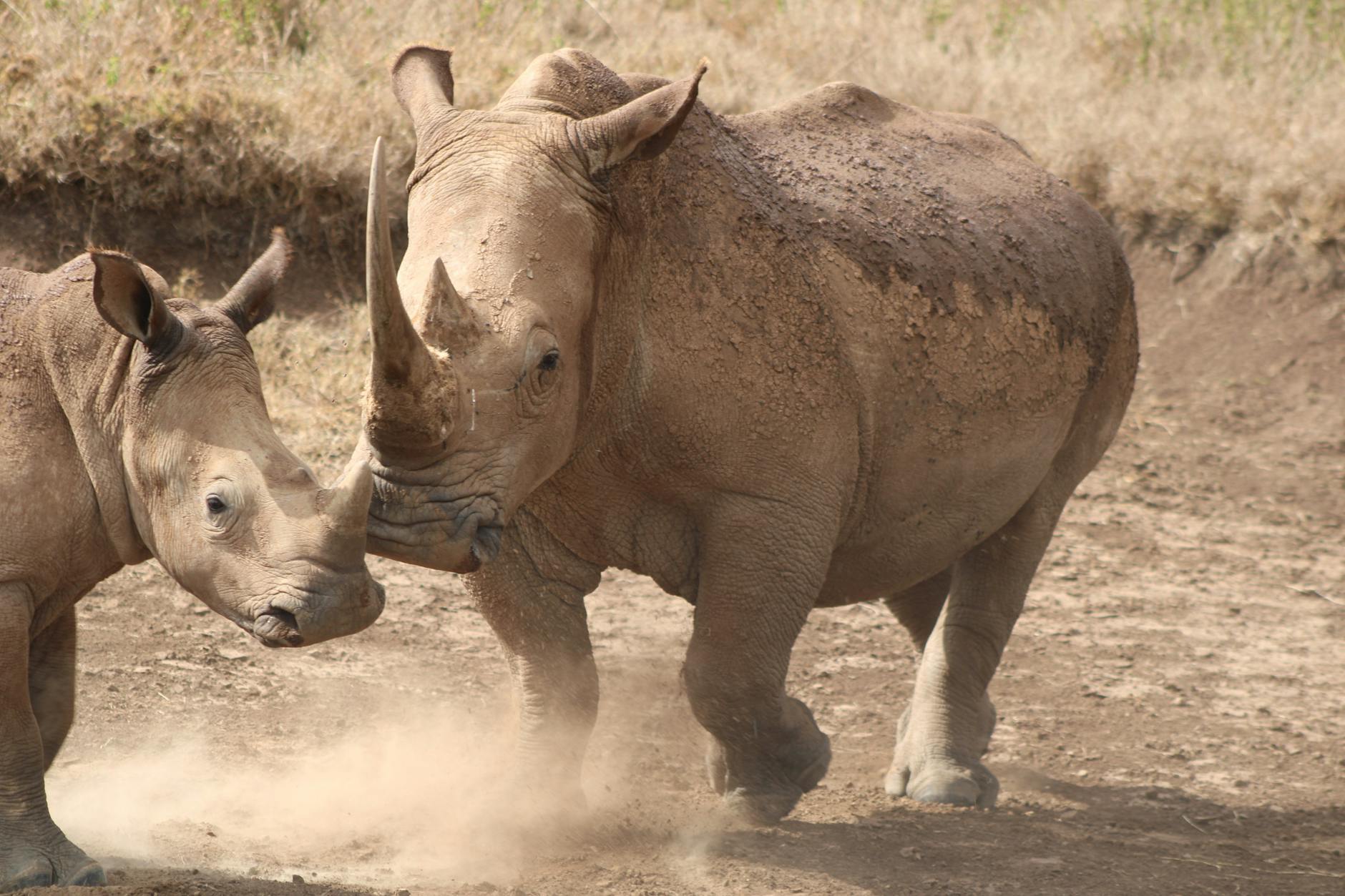
Few lessons land as powerfully as learning about endangered species in the very place they’re being saved. Laikipia offers children unforgettable encounters with some of the world’s most threatened animals: the last two northern white rhinos on earth at Ol Pejeta, a profoundly moving lesson in extinction; black rhinos being protected and recovered; the endangered Grevy’s zebra, of which Laikipia holds a large share of the world population; and African wild dogs, one of the continent’s rarest carnivores. Meeting these animals and learning why they’re endangered — habitat loss, poaching, human pressure — and how they’re being saved gives children a visceral, emotional understanding of conservation that no documentary can match. It teaches biology, ecology, ethics and hope all at once, and often sparks a lasting determination to protect wildlife. Children who have stood before the last northern white rhinos rarely forget it, and carry the lesson for life. Learning about endangered species in Laikipia is education at its most powerful — real, emotional and unforgettable — and a highlight of any educational family safari here.
Astronomy and the Night Sky
An often-overlooked educational treasure of a Laikipia safari is the night sky. Far from city lights, the plateau offers some of the darkest, clearest, most star-filled skies on earth, and stargazing becomes a wonderful, awe-inspiring astronomy lesson for children. With the naked eye, or a telescope or good binoculars where available, children can pick out constellations, planets, the Milky Way blazing overhead, and shooting stars. Being near the equator means you can see stars of both the northern and southern hemispheres, a geography and astronomy lesson in itself. Many lodges and guides can point out constellations and share both the science and the stories — including local cultural interpretations of the stars. For children used to light-polluted skies, the sheer abundance of stars is genuinely astonishing and memorable. Stargazing teaches astronomy and physics, sparks wonder about the universe, and provides magical, quiet family moments after the day’s adventures. It costs nothing extra, requires only clear skies, and adds a whole cosmic dimension to the educational richness of a Laikipia safari — a reminder that the learning extends from the smallest insect track to the farthest stars.
Bringing the Learning Home
The education needn’t end when the safari does — in fact, some of the most valuable learning happens afterward, as children process and build on what they experienced. Encourage them to share their adventure: a school presentation or project about their trip, the animals and conservation cements the learning and lets them teach others. The wildlife journal, photos and souvenirs become the basis for scrapbooks, stories or displays. Children often return with a new or deepened interest — in wildlife, conservation, photography, geography or other cultures — that can be nurtured through books, documentaries, local nature activities, or supporting a conservation cause they connected with. Some families ‘adopt’ an animal or support a conservancy they visited, keeping the connection alive. Discussing what they saw and learned, and how they can help protect wildlife, extends the trip’s impact. By consciously bringing the learning home and building on it, parents turn a wonderful holiday into a lasting educational and even life-shaping experience. The safari becomes not a one-off but the spark for an ongoing engagement with the natural world, which is perhaps its greatest educational gift of all.
Educational Value for Different Ages
The educational rewards of a Laikipia safari differ by age, and knowing what each stage takes away helps parents pitch the experience. Young children (around 5–7) absorb a love of animals and nature, basic facts and a sense of wonder, learning through play, programs like the junior ranger scheme, and direct encounters; the emotional connection matters more than detailed knowledge. Tweens (8–12) can grasp ecology, conservation issues, animal behaviour and the bigger picture, engaging deeply with tracking, conservation experiences and the science of it all — often a transformative age for sparking real passion. Teens can engage at a near-adult level with the complexities of conservation, the ethics, the science and the human dimensions, and may be genuinely inspired toward future study or careers. Even toddlers gain from the exposure and family experience, though they won’t recall specifics. Understanding what your children’s ages allow them to take away helps you choose the right activities and pitch the learning appropriately, ensuring each child gets the most from the extraordinary living classroom that is a Laikipia safari, whatever their stage.
Frequently Asked Questions
How can I prepare my child to learn before a safari?
Start weeks ahead: read books about African wildlife and conservation together, watch nature documentaries, look at maps and a globe to locate Laikipia and the equator, and talk about what you’ll see. Let children research an animal they’re excited about. This primes them to recognise and understand what they encounter, deepening engagement and turning each sighting into a thrilling moment.
What can kids learn about endangered species in Laikipia?
Laikipia offers unforgettable encounters with the world’s most threatened animals — the last two northern white rhinos at Ol Pejeta, recovering black rhinos, endangered Grevy’s zebra (Laikipia holds a large share of the world population) and rare African wild dogs. Learning why they’re endangered and how they’re saved gives children a powerful, emotional understanding of conservation that sticks for life.
How do I extend the learning after the safari?
Encourage children to share their adventure through a school project or presentation, make scrapbooks from their journal and photos, and nurture any new interest in wildlife, conservation or photography through books, documentaries and local nature activities. Some families adopt an animal or support a conservancy they visited. Bringing the learning home turns a holiday into a lasting, even life-shaping experience.
What can children learn on a Laikipia safari?
A huge amount — ecology and how ecosystems work, animal behaviour and tracking, conservation and why species become endangered, wildlife biology, geography (including the equator), and different cultures through Samburu and Maasai encounters. Because Laikipia is Kenya’s conservation heartland, children can witness real conservation in action, making the learning vivid, emotional and unforgettable.
What educational programs are there for kids in Laikipia?
The Ol Pejeta Junior Ranger program (ages roughly 4–12) teaches tracking, fire-building, survival and conservation, ending with a ranger oath and certificate. El Karama’s Bush School teaches bush skills through crafts, track-casting and scavenger hunts. Many lodges offer guided learning, conservation experiences and cultural visits. These programs educate through hands-on fun rather than instruction.
Why is Laikipia good for an educational safari?
Because it’s where conservation actually happens. Unlike a national park where you just watch wildlife, Laikipia’s conservancies let children engage with real conservation — anti-poaching, endangered species recovery, community partnerships — and meet the last northern white rhinos. This turns abstract concepts into tangible, emotional, lasting lessons no classroom can match.
How do I make a safari educational without it feeling like school?
Let the learning happen naturally through excitement and play. Follow your children’s curiosity, let great guides and kids’ programs teach through fun activities, and avoid turning everything into a quiz. Provide simple tools like a wildlife journal and binoculars, choose lodges with kids’ programs, and let the real, thrilling experiences do the teaching. Children learn best when enthralled.
What is a wildlife journal and why is it good for kids?
It’s a notebook where children record and sketch the animals they see, note behaviours and write about their experiences. It sharpens observation, reinforces learning, gives purpose to game drives, and becomes a treasured keepsake. Combined with a wildlife checklist and even simple citizen-science recording, journaling turns passive watching into active, meaningful learning.
Plan an enriching trip with our guides to kids’ activities, conservation experiences, and the full Laikipia family safari guide.