Last updated: June 2026
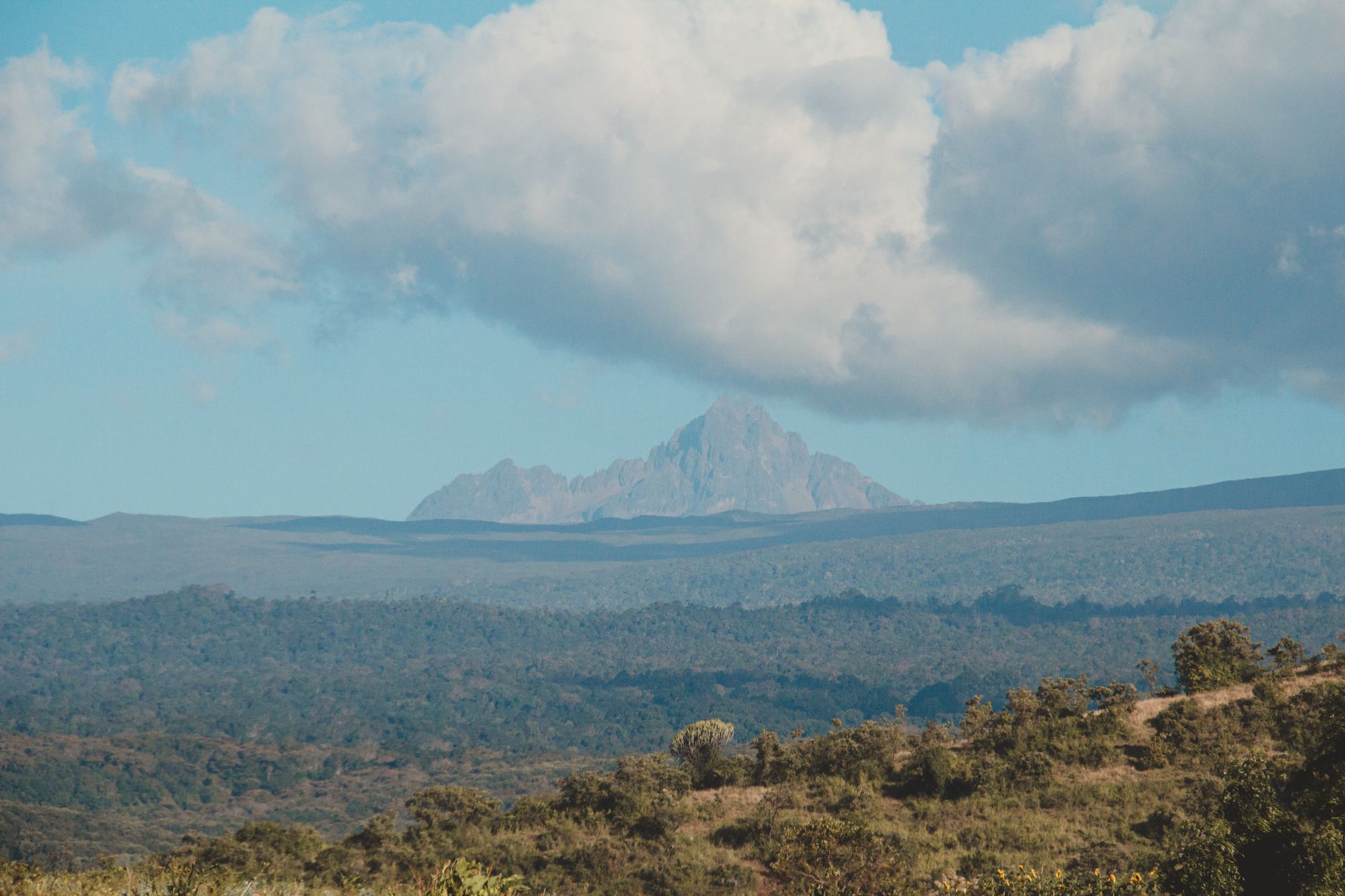
You don’t so much visit Mount Kenya from Laikipia as live beneath it. On a clear morning the mountain fills the southern sky — jagged glacier-carved peaks floating above a collar of forest — and almost every lodge on the plateau frames its breakfast view around it. For a great many travellers, that snow-dusted equatorial summit is the defining backdrop of their Laikipia safari. But you can do far more than admire it from a distance. Mount Kenya from Laikipia can mean a sunrise photograph, a half-day forest hike, a day trip to the moorland, or a full multi-day trek to one of Africa’s most beautiful peaks. This guide covers all of it — the best viewpoints, the trekking routes from the Laikipia side, day-trip options, and how to fold the mountain into a wider safari.
The Mountain in Brief
Mount Kenya is Africa’s second-highest mountain, after Kilimanjaro, rising to 5,199 metres at its highest point, Batian. Its three main summits — Batian (5,199 m) and Nelion (5,188 m), which require technical climbing, and Point Lenana (4,985 m), which trekkers can reach — are the eroded remains of an ancient volcano. The mountain is a UNESCO World Heritage Site, ringed by forest, bamboo and surreal high-altitude moorland studded with giant lobelias and groundsels found almost nowhere else on Earth. Laikipia sits along its northern and north-western flank, which gives the plateau both its spectacular views and its access to the quieter trekking routes.
Best Mount Kenya Viewpoints in Laikipia
If you simply want the view — and it is a view worth crossing continents for — Laikipia delivers it generously. Many lodges and camps are positioned and oriented specifically to capture the mountain at dawn, when the rising sun lights the peaks pink and gold before cloud rolls in around mid-morning. The Ol Pejeta plains, with the mountain rising behind grazing rhino, offer one of Kenya’s most iconic safari compositions. The high, open country of Borana and Loisaba serves up enormous uninterrupted vistas. Even the famous equator crossing at Nanyuki sits in the mountain’s shadow.
Photographer’s tip: the mountain is almost always clearest at first light and again briefly at sunset; by late morning it usually hides behind its own weather. Shoot early. For more on capturing it, see our Laikipia wildlife photography guide.

Trekking Routes from the Laikipia Side
Mount Kenya has several established routes, and the ones most accessible from Laikipia and Nanyuki are Sirimon, Burguret and Timau. Each has a very different character.
Sirimon Route
Sirimon is the classic Laikipia-side approach and the most popular northern route. The gate sits north-west of the mountain, reached easily from Nanyuki, and the path climbs relatively gently through dry forest into the scenic Mackinder Valley. Two well-equipped overnight stops — Old Moses Camp (around 3,300 m) and Shipton’s Camp (around 4,200 m) — make it comfortable by mountain standards, with huts, dormitories, toilets and camping. It offers superb views of the main peaks and the bizarre giant lobelias and groundsels of the high moorland, and is a favourite ascent route toward Point Lenana.
Burguret Route
Burguret is for the adventurous and experienced. A remote, rarely used path through dense forest and moorland, it has no huts, no established campsites and very little foot traffic — which means route-finding skills, a fully self-sufficient team and a strong guide are essential. The reward is genuine wilderness and the chance of having the mountain almost entirely to yourself.
Timau Route
The Timau Route approaches from the north and is one of the least-used on the mountain, crossing dry northern moorland with a stark, almost Kilimanjaro-like character. It’s a quiet, scenic alternative for trekkers who want solitude over infrastructure.
Day Trips to Mount Kenya from Nanyuki
You don’t need to commit to a multi-day expedition to set foot on the mountain. A popular day trip from Nanyuki runs up the Sirimon route: drive about 13 km toward Timau, turn onto the murram road, and reach the Sirimon Gate at around 2,650 m. From there you can hike up through forest and into the moorland toward Old Moses Camp and the viewpoints, soaking in the high-altitude scenery and the main-peak vistas before descending the same day. It is the most affordable and time-efficient way to experience Mount Kenya’s forest and moorland zones, and it slots neatly into a Laikipia itinerary without the logistics of a summit attempt.

A Sample Sirimon Trek to Point Lenana
To picture a typical summit trip from the Laikipia side, here’s how a classic four-day Sirimon ascent unfolds. Day one: drive from Nanyuki to the Sirimon Gate (about 2,650 m) and trek gently through forest to Old Moses Camp (3,300 m). Day two: a longer day up the scenic Mackinder Valley to Shipton’s Camp (4,200 m), watching the vegetation shrink into giant lobelias and groundsels. Day three: a pre-dawn start — head-torch on, frost underfoot — for the steep push to Point Lenana (4,985 m) in time for sunrise over the glaciers, then a long descent. Many itineraries descend via the Chogoria route for variety, giving the famous views over the Gorges Valley and Lake Michaelson. The pace is deliberately unhurried to aid acclimatisation; rushing is the surest way to fail. Shorter and longer versions exist, but four to five days is the sweet spot for safely reaching Lenana.
The Mountain’s Wildlife and Flora
Mount Kenya is a vertical journey through ecosystems. The lower slopes are dense montane forest and bamboo, home to elephant, buffalo, bushbuck and colobus monkeys — which is exactly why the forest hikes are guided. Higher up, the forest gives way to heath and then to the otherworldly Afro-alpine moorland, where giant lobelias stand like candelabra and groundsels grow into surreal cabbage-topped trees found only on East Africa’s high peaks. Rock hyrax scurry around the camps, and high-altitude birds patrol the ridges. It’s a botanist’s wonderland as much as a mountaineer’s, and part of why the mountain earned its UNESCO World Heritage status. Birders should pair this with our Laikipia birdwatching guide.
The History and Legend of Mount Kenya
To the Kikuyu people, who live on the mountain’s southern and western slopes, Mount Kenya is not just scenery — it is sacred. They call it Kirinyaga, “the place of brightness,” and traditionally believe it to be the earthly dwelling of Ngai, the creator god. Homes were once built with doors facing the peaks, and the mountain remains central to Kikuyu identity and prayer. The country itself takes its name from the mountain. The first European to report it, in 1849, was the missionary Johann Ludwig Krapf, who was met with disbelief back home at his claim of snow and glaciers on the equator. Batian and Nelion, the twin highest peaks, are named after two great Maasai laibons (spiritual leaders), Mbatian and his son. Knowing this history adds a quiet depth to standing beneath the mountain — you’re looking at something that has been holy ground for centuries, not merely a trekking objective. Our guide to the peoples and cultures of Laikipia explores these communities further.
Glaciers, Climate and a Changing Mountain
Mount Kenya is one of only a handful of places on the equator to carry permanent ice, and its glaciers are among the most poignant climate indicators in Africa. They have retreated dramatically over the past century — the mountain has lost the great majority of its glacial ice, and scientists expect the remaining ice to vanish within decades. For trekkers, this means the snow-and-ice character of the high peaks is genuinely fading, lending an elegiac quality to a summit trip: you are seeing something your grandchildren may not. The retreating ice also affects the rivers that flow off the mountain — including the spring-fed streams that feed places like Ngare Ndare and sustain the wider Laikipia ecosystem downstream. The mountain is the water tower for this whole region.
Preparing for Altitude
If there’s one thing that determines whether you reach Point Lenana, it’s how you handle the thin air. Above roughly 3,000 m, the body needs time to adjust, and pushing too high too fast causes altitude sickness — headaches, nausea, breathlessness — that ends many summit attempts. The remedies are simple but non-negotiable: choose an itinerary with enough days (four to five for Lenana via Sirimon, not two or three), ascend slowly, drink far more water than feels necessary, and “climb high, sleep low” where the route allows. Spending your first nights at altitude on the Laikipia plateau (1,700–2,000 m) before a trek gives you a useful head start. Listen to your guide and your body; summit fever is the enemy. Anyone with heart or lung conditions should consult a doctor before attempting the upper mountain.
Combining a Mount Kenya Climb with Your Laikipia Safari
One of Laikipia’s great advantages is how naturally a mountain trek pairs with a safari. A classic combination is to summit Point Lenana over three to four days via Sirimon, then descend to the plateau for a few days of game viewing, walking and rest at a conservancy lodge — a perfect contrast of effort and reward. Because Nanyuki is the shared gateway for both, transfers are simple. If you’re building this kind of trip, our guides to Laikipia safari itineraries and planning your Laikipia trip will help you sequence it sensibly — typically mountain first (while you’re fresh and to aid acclimatisation), safari after.
Permits, Guides and Costs
Climbing Mount Kenya requires Kenya Wildlife Service park fees, charged per day and differing for non-residents, residents and citizens, plus the cost of a licensed guide, porters and (on most routes) hut or camping fees. Reputable operators bundle these into a package price covering permits, crew, meals and equipment — far simpler than arranging piecemeal, and safer. Day hikes up the Sirimon route are the most affordable way to set foot on the mountain, requiring only a single day’s park fee and a guide. Always book through a licensed outfitter; independent high-altitude trekking is neither permitted in the spirit of the park rules nor wise. Budget context lives in our Laikipia safari cost guide.
Other Routes and the Bigger Picture
While Sirimon, Burguret and Timau are the Laikipia-side approaches, it’s worth knowing the wider context. The Naro Moru route on the west is the fastest (and steepest, via the infamous “vertical bog”) and is often used for descent; the Chogoria route on the south-east is widely considered the most beautiful, passing the Gorges Valley and Lake Michaelson. A popular strategy is to ascend Sirimon for its gentle acclimatisation profile and descend Chogoria for the scenery — the best of both. From a Laikipia base, your operator will usually start you at Sirimon regardless of the descent route.
When to Go
For both views and trekking, the dry seasons are best: roughly January–February and June–October bring the clearest skies, the most reliable mountain views and the safest trail conditions. The long rains (March–May) and short rains (November) can make the upper mountain treacherous and obscure the peaks behind cloud, though the lower forest is gorgeously green. Whatever the month, dawn is your friend for views. See our best time to visit Laikipia guide for detail.
Practical Tips
Respect the altitude. Point Lenana is just under 5,000 m, and altitude sickness is the main reason people fail to summit. Choose itineraries with proper acclimatisation, ascend slowly, and hydrate.
Use a licensed guide and outfitter. Mount Kenya treks require Kenya Wildlife Service park fees and, for safety, a qualified guide and porter team. Book through a reputable operator.
Pack for four seasons. You can start in warm forest and finish in sub-zero, pre-dawn summit conditions. Layers, a warm jacket, hat, gloves and a headtorch are essential for higher routes.
Start early for views. Whether you’re trekking or just photographing from your lodge, the mountain reveals itself at first light and hides by mid-morning.
What to Pack for a Mount Kenya Trek
The mountain demands more kit than a day on the plains, because you’ll pass through several climate zones in a single trip. The essentials: well-broken-in waterproof hiking boots, warm insulating layers (fleece and a down jacket), a waterproof shell, thermal base layers for the summit night, a warm hat and gloves, and a sun hat and high-factor cream for the intense equatorial daytime sun. A four-season sleeping bag is vital for the cold camps, along with a headtorch for the pre-dawn summit push, trekking poles for the descents, and a refillable water bottle or hydration bladder. Reputable outfitters provide tents, mess facilities and porters, but confirm exactly what’s included. Keep a small daypack for the day’s water, snacks, camera and a layer, while porters carry the heavy bags. Pack light but never skimp on warmth — being cold and wet at altitude is what turns a wonderful trek into a miserable one.
Is Mount Kenya Right for You?
Mount Kenya rewards a wide range of travellers, but it helps to be honest about which experience suits you. If you simply love the idea of the mountain, the lodge views and a forest day hike will more than satisfy — no special fitness needed. A Sirimon day trip to the moorland asks for moderate fitness and a head for a long day out. Reaching Point Lenana is a genuine high-altitude trek: no technical climbing, but several days of sustained walking to nearly 5,000 m, where determination and acclimatisation matter more than raw athleticism. The technical summits of Batian and Nelion are for experienced rock climbers only. Match your ambition to your fitness and your days available, and you’ll have a far better time. Our trip-planning guide can help you fit the right option around your wider safari.
Frequently Asked Questions
Can you see Mount Kenya from Laikipia?
Yes — spectacularly. Laikipia lies along the mountain’s northern and north-western flank, and most lodges are oriented to capture the peaks, which are clearest at sunrise. Ol Pejeta, Borana and Loisaba offer especially fine views.
How do you climb Mount Kenya from Nanyuki?
The most popular route from the Nanyuki/Laikipia side is the Sirimon route, accessed via the Sirimon Gate at about 2,650 m. Trekkers typically ascend over three to four days via Old Moses and Shipton’s camps toward Point Lenana (4,985 m), the highest point reachable without technical climbing.
Can you do a Mount Kenya day trip from Laikipia?
Yes. A day hike up the Sirimon route from Nanyuki lets you experience the forest and moorland zones and the main-peak views, reaching toward Old Moses Camp before descending the same day — no overnight or summit attempt required.
How high is Mount Kenya?
Mount Kenya’s highest peak, Batian, reaches 5,199 metres, making it Africa’s second-highest mountain after Kilimanjaro. Trekkers can reach Point Lenana at 4,985 m; Batian and Nelion require technical climbing.
What’s the best time to trek Mount Kenya?
The dry seasons — January to February and June to October — offer the clearest skies and safest trail conditions. Avoid the long rains of March to May for high routes.
Mount Kenya is the crown of any Laikipia trip. Pair it with the rest of the region’s things to do, and plan the whole adventure with our complete guide to Laikipia Kenya.


1 comment