Last updated: June 2026
Laikipia feels remote — and in the best sense it is — but getting there is far easier than first-time visitors expect. From the moment you land in Nairobi you are usually only a short flight or a half-day’s drive from the plateau, and the journey itself, climbing from the city into the cool highlands beneath Mount Kenya, is part of the pleasure. This guide lays out every realistic way to get to Laikipia Kenya — scheduled flights, private charters, self-driving and road transfers — with honest pros, cons and costs for each, so you can choose the option that fits your budget, your itinerary and your appetite for adventure.
Whether you’re heading to a remote northern conservancy, a lodge near Nanyuki, or combining Laikipia with the wider Kenyan safari circuit, the logistics come down to two questions: fly or drive, and where exactly are you going. We’ll answer both, and fold in the practical details — transfer times, airstrips, luggage limits and booking tips — that make the difference between a smooth arrival and a frazzled one.
Where Is Laikipia, and Why Access Is Easy
Laikipia sits in central Kenya, on the high plateau north-west of Mount Kenya, roughly 200 km north of Nairobi. Its gateway town is Nanyuki, which sits almost exactly on the equator and serves as the hub for flights, road transfers, supplies and self-drive logistics. Because Laikipia is a patchwork of private and community conservancies rather than one national park, your exact destination — Ol Pejeta, Lewa, Loisaba, Borana, the northern wilderness — determines the last leg of your journey. The good news is that all routes funnel through either Nairobi or Nanyuki, both well connected.
Option 1: Scheduled Flights from Nairobi
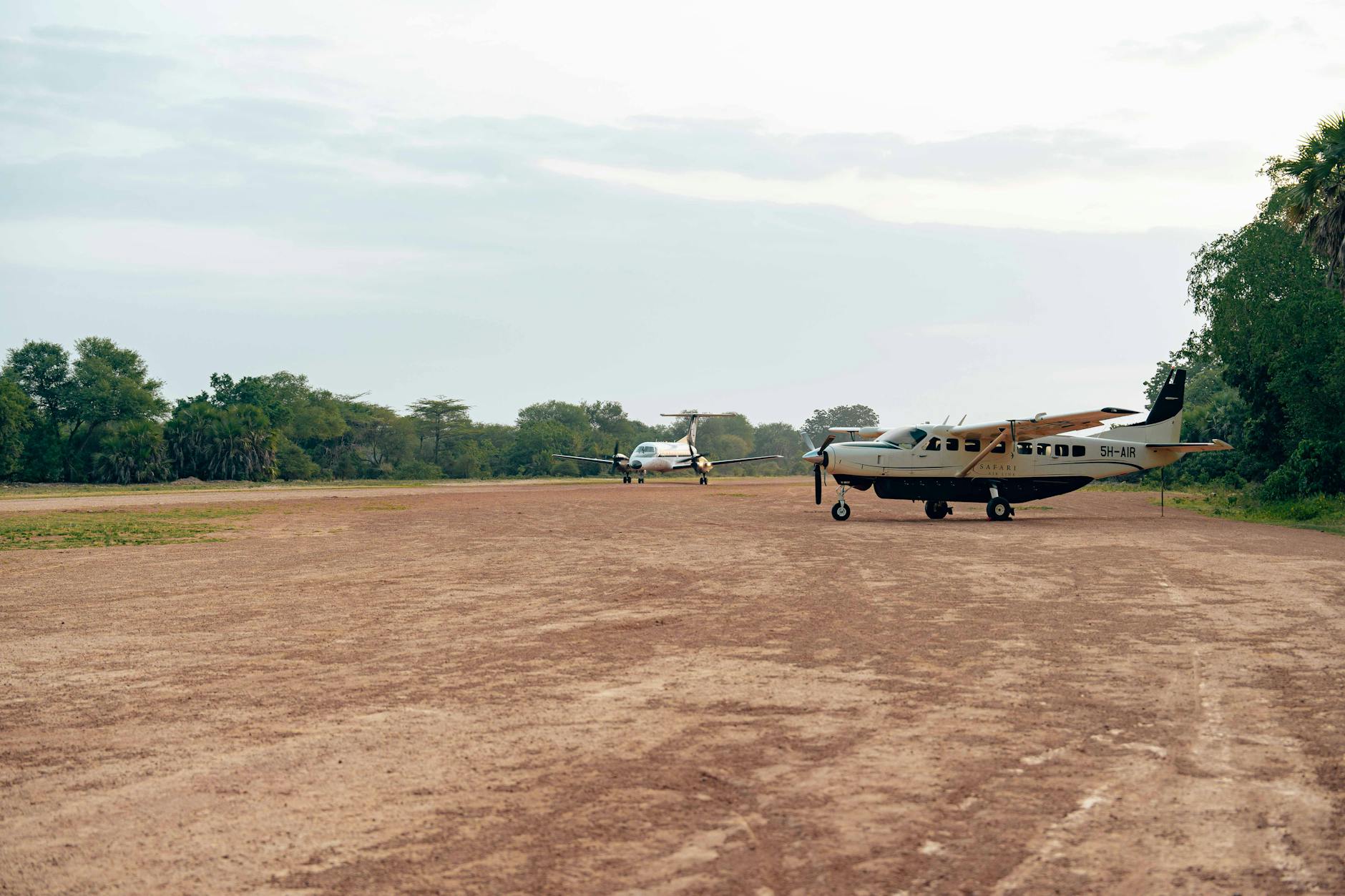
For most international visitors, flying is the simplest and most popular way in. After arriving at Jomo Kenyatta International Airport (JKIA), you transfer to Nairobi’s Wilson Airport, the hub for domestic safari flights, and take a short scheduled flight north. Two airlines dominate this route — Safarilink and AirKenya — and between them they serve Nanyuki as well as airstrips at Lewa, Loisaba, Samburu and other conservancies.
Flights to Nanyuki run roughly twice daily and take well under an hour, versus three to four hours by road — a huge time saving, and a spectacular aerial view of the Aberdares and Mount Kenya thrown in. The key thing to know is the strict baggage limit: because these are small aircraft, you’re generally restricted to around 15 kg per person including hand luggage, in a soft-sided bag. Pack accordingly (see our Laikipia packing list), and check in at Wilson at least an hour before departure. We cover the airline detail, schedules and airstrips in our dedicated Nanyuki Airport guide.

Option 2: Private and Charter Flights
If you’re heading to a remote conservancy, travelling as a group, or simply want maximum flexibility, a private charter flight is worth considering. Charters can land directly on the airstrip nearest your lodge — Loisaba, Mugie, Ol Lentille and the northern conservancies all have their own — saving a long road transfer at the far end. Many high-end lodges can arrange these as part of your package, and they’re often more cost-effective than they sound once you split the price across a family or group. Charters also let you island-hop between safari regions without backtracking to Nairobi, which is invaluable if you’re combining Laikipia with the Mara or Samburu; see our guide to combining Laikipia with other destinations.
Option 3: Driving from Nairobi
The road journey from Nairobi to Nanyuki is genuinely pleasant and, for many, part of the adventure. The route runs north on the well-surfaced A2 highway, climbing steadily through Thika, past the Aberdares, and into the highlands — roughly 200 km, taking around three to four hours depending on traffic leaving Nairobi and the inevitable livestock and matatus along the way. The tarmac is good for the main stretch; it’s only on the final approaches to individual conservancies that the roads turn to murram (graded dirt) and a 4×4 becomes essential.
You can drive yourself (see our self-driving in Laikipia guide) or, far more commonly, be driven by a private transfer or your tour operator’s driver-guide. A private road transfer from Nairobi is comfortable, lets you stop at the equator and other points en route, and avoids the Wilson Airport shuffle — though it does eat half a day. It’s a good choice if you’re nervous about tiny planes, travelling with lots of luggage, or value the scenery.
Option 4: Road Transfers to Your Conservancy
However you reach Nanyuki — by air or road — there’s usually a final leg out to your lodge or conservancy. Central properties like those on Ol Pejeta are just 30–45 minutes from Nanyuki; northern conservancies can be one to three hours further on rougher roads. Most lodges arrange this transfer for you, often in an open safari vehicle so the journey doubles as your first game drive. Confirm who is meeting you and where when you book, especially if you’re flying in, as airstrips can be a short drive from the lodge itself.

Flying vs Driving: Which Should You Choose?
The honest answer depends on your priorities. Fly if your time is limited, you’re heading to a remote conservancy, you want to maximise safari time, or you simply prefer to skip a long drive — the time saving is enormous and the aerial views superb. Drive if you’re on a tighter budget, travelling with bulky luggage or young children, want the flexibility to stop along the way, or are nervous about small aircraft. Many visitors do both: fly in to save time and road-transfer out (or vice versa) to see the countryside. Your itinerary and budget will usually make the choice clear.
Getting to Laikipia from Mombasa or the Coast
If you’re combining a beach holiday with your safari, you can reach Laikipia from the coast too. The simplest route is a domestic flight from Mombasa (or Diani) back to Nairobi Wilson, then onward to Nanyuki — the safari airlines schedule these connections. Driving from the coast is possible but very long (a full day-plus) and rarely worth it given the affordable flight links. Plan coast-to-Laikipia trips with a buffer day in Nairobi if connections are tight.
Combining Laikipia with Other Safari Regions
One of Laikipia’s strengths is how easily it links to the rest of Kenya’s circuit. The safari airlines connect Nanyuki and the conservancy airstrips to the Masai Mara, Samburu, Amboseli and beyond, so you can build a multi-region trip without endless backtracking — fly Mara to Nanyuki, for instance, with a quick touchdown at Wilson. Samburu, just to the north, pairs especially naturally with Laikipia. For ideas on stitching it together, see our guides to combined safaris and Laikipia itineraries.
Costs and Booking Tips
Scheduled flights to Nanyuki are typically the mid-range option, charters the priciest (though shareable), and self-driving or shared road transfers the cheapest. Book domestic flights well ahead in peak season (they fill up, and small planes have limited seats), and let your lodge or operator coordinate transfers so nobody is left waiting at an airstrip. Build in a comfortable connection at JKIA/Wilson — allow at least three to four hours between an international arrival and a domestic safari flight, as you must transfer between the two Nairobi airports. For the full money picture, see our Laikipia safari cost guide, and sort your entry paperwork early via our Kenya visa & eTA guide.
Practical Tips for a Smooth Arrival
Respect the luggage limit. Light, soft-sided bags (around 15 kg total) are essential for safari flights — see our packing list.
Allow generous connection time. JKIA to Wilson is a 30–60 minute drive across Nairobi; don’t book a tight onward connection.
Confirm transfers in writing. Know who is meeting you, where, and what their phone number is — useful if flights shift.
Sort your eTA early. You need approved travel authorisation before you fly; apply at least a week ahead.
Avoid driving at night. If self-driving, reach your destination before dark — Kenyan roads after sunset are best avoided.
Sample Journey Timelines
To picture how a travel day flows, here are two typical scenarios. Flying in: land at JKIA mid-morning, clear immigration with your eTA, transfer 30–60 minutes across Nairobi to Wilson Airport, take an early-afternoon flight under an hour to Nanyuki, and be at a central conservancy lodge in time for an afternoon game drive — the whole day, door to bush, done by late afternoon. Driving in: leave Nairobi after breakfast, stop at the equator for a leg-stretch, reach Nanyuki by early afternoon (three to four hours), then transfer out to your lodge. Either way, aim to arrive in daylight, and never plan to reach a remote conservancy after dark.
Travelling with Children or Lots of Gear
Families and anyone with bulky equipment face a real trade-off. Safari flights save hours but cap you at around 15 kg of soft luggage per person, which is tight with car seats, kids’ kit or camera gear. A private road transfer, while slower, removes the baggage stress entirely and lets restless children stop and stretch — often the saner choice for young families. If you do fly, a private charter offers more baggage flexibility than scheduled services. Our family safari guide has more on travelling with kids, and the packing list helps you keep within limits.
Reaching the Northern Conservancies
The far northern reaches of Laikipia — Loisaba, the Mukutan area and the community conservancies beyond — are more remote, and here flying really comes into its own. A scheduled or charter flight to a conservancy airstrip can save a long, rough road transfer of several hours from Nanyuki. If you’re road-tripping, allow plenty of time, travel in a 4×4, and confirm the route condition locally, especially in the rains. These northern properties reward the extra effort with genuine wilderness and few other visitors.
Booking the Whole Journey Together
The smoothest trips are the ones where the legs are coordinated. Whether you book through a tour operator or arrange things yourself, make sure your international arrival, domestic flight or transfer, and lodge pickup all connect with sensible buffers — and that someone owns the hand-offs. A good operator or your lodge will sequence flights and transfers so you’re never stranded at an airstrip wondering who’s coming. If you’re self-organising, build in slack at JKIA/Wilson and confirm every pickup in writing with a phone contact. See our itinerary guide for how the pieces fit.
Making Arrival Day Smooth
A few habits keep your first day stress-free. Pre-clear your eTA and have it printed; keep your lodge’s name and your transfer driver’s phone number on your phone and on paper; and carry a small amount of US dollars and shillings for any incidentals before you reach an ATM. Wear or carry a warm layer in your hand luggage — even if you land in warm Nairobi, the Laikipia evenings are cool. If you have a long gap at Wilson Airport between flights, there are cafés to wait in, and the safari-airline desks are used to nervous first-timers and happy to help. Arrive expecting the day to unfold gently, and it usually does.
Getting Around Once You’re There
Within Laikipia, most visitors don’t need their own transport at all: lodges run the game drives, walks and excursions, and arrange any transfers between properties or to attractions like the equator or Ngare Ndare Forest. If you want independence for town errands and day trips, you can hire a vehicle (see self-driving in Laikipia) or arrange a local driver through your lodge or in Nanyuki. For getting between conservancies that are far apart, a short hop on a scheduled or charter flight often beats a long, bumpy drive — worth factoring into a multi-property itinerary.
Choosing the Right Arrival for Your Trip Style
Every traveller weighs the journey differently, and it helps to match the arrival to the kind of trip you want. If this is a once-in-a-lifetime safari and time is precious, fly — every hour saved on the road is an hour watching elephants instead, and the aerial approach to the plateau is a memory in itself. If you’re a curious, budget-minded explorer who enjoys the texture of a country, the drive up the A2 through the highlands, with a pause at the equator and a roadside chai stop, is part of the story rather than an obstacle to it.
Families, photographers and anyone hauling specialist gear should think hardest about luggage and comfort, since the safari flights are strict on weight and space. And travellers heading to the remote north almost always benefit from flying at least one leg, simply because the road transfers out there are long. There’s no universally right answer — only the one that fits your priorities, your budget and your itinerary. Many of the best trips mix both: fly one way for speed, drive the other for the scenery.
A Pre-Departure Travel Checklist
Pulling it together, here’s the short list that makes the journey to Laikipia painless. Confirm your eTA is approved and printed, and that your passport has six-plus months’ validity. Reconfirm your domestic flight times or transfer a day or two ahead, and check which airstrip you’re landing at. Pack within the soft-bag, ~15 kg limit for any safari flight, with a warm layer and your valuables in your carry-on. Carry a little cash in dollars and shillings, your lodge’s details and your driver’s number, and your insurance documents.
Allow a generous connection between your international arrival and any onward safari flight — three to four hours minimum, since JKIA and Wilson are separate airports across town. Aim to reach your final destination in daylight, especially if any leg is by road. Tick those off and the trip from your front door to your first sundowner on the plateau unfolds about as smoothly as long-haul travel ever does. From here, the planning gets purely enjoyable — see the full Laikipia travel planning guide.
Frequently Asked Questions
How do you get to Laikipia from Nairobi?
The two main options are a short scheduled flight from Nairobi’s Wilson Airport to Nanyuki or a conservancy airstrip (under an hour, twice daily with Safarilink or AirKenya), or a road journey of about 200 km / three to four hours up the A2 highway. Many visitors fly in to save time and drive one leg for the scenery.
Is there an airport in Laikipia?
Yes — Nanyuki Airport is the main gateway, served by scheduled safari flights from Nairobi Wilson, and several conservancies (Lewa, Loisaba and others) have their own airstrips for scheduled and charter flights.
How long does it take to drive from Nairobi to Nanyuki?
Roughly three to four hours for the 200 km on the tarmac A2 highway, depending on Nairobi traffic. The final leg to your specific conservancy may add 30 minutes to a few hours on murram roads, where a 4×4 is needed.
What is the baggage limit on flights to Laikipia?
Safari airlines like Safarilink generally limit you to around 15 kg per person including hand luggage, in a soft-sided bag, because the aircraft are small. Pack light and check the exact allowance with your airline.
Do I need a 4×4 to get to Laikipia?
Not for the main tarmac route to Nanyuki, but yes for the final approaches to most conservancies and for any self-driving within them. If your lodge arranges your transfer, they’ll use an appropriate vehicle. See our self-drive guide.
Getting there is the first step — now plan the rest with our complete Laikipia travel planning guide and the complete guide to Laikipia Kenya.